
Soil Test

I had a soil test of my garden done last summer, and I’ve been meaning to post the results.  Since they are in Dutch, and probably not many of my readers can understand them as they are, I will attempt to translate.  However the original report can be found here.

You can compare this to my earlier do-it-yourself efforts at soil testing.

Measured values are given first, followed by target values in parenthesis if these are given in the original report.

Organic Material   10.3%

Calcium                 2-5%

pH (KCl method)     7.2  (>6.4)

Available Nutrients:

Phosphorus              58   (45)

Potassium                22   (21)

Magnesium              230  (125)

Nitrogen                  1.4  (1.0)

Unavailable Nutrients:

Phosphorus               1370  (1000)

Potassium                     5  (7)

Biological Activity:

Detected mg of CO2 per 100g per 7 days     86   (70)

Conclusions and Advice:

Conclusion:  Soil has a high organic content, and a good pH level.  For most nutrients, there is sufficient to excessive available and unavailable amounts.  There is sufficient nitrogen and biological activity.

Advice:  Add 300 liters of fresh manure or high quality compost per 100m2. As an alternative, 50 liters of dried cow manure per 100m2.  The actual amount varies with crops grown.  Lime loving plants (soft fruit, potatoes, cabbage, carrots, etc) 2 kg of (dolomite) lime per 100m2.  Nitrogen loving plants (soft fruit, potatoes, leaf vegetables, cabbage, beet, etc) only in case of slow growth 500g nitrogen per 100m2 in the form of dry organic fertilizer.  For example, this can be 4Kg bone or blood meal per 100m2.  Further fertilizing is not necessary.

The advice seems to be open to some interpretation.  I probably don’t add quite as much compost as they say here, and I don’t add any of the other fertilizers or manures, but since they say amounts vary with crops grown I guess you could say I’m following the advice.  It’s worth mentioning I also grow a lot of nitrogen fixing plants.

At the same time I could be adding an awful lot of manures and nitrogen fertilizers and also be following the advice.  300 liters of fresh manure per 100m2 is an awful lot!

I think it’s more a part of the culture here to depend on soluble nitrogen in the form of manures or fertilizers, rather than fixed nitrogen, and that may be part of the reason the advice is given in the way it is.  The test doesn’t seem to show fixed nitrogen.

The excessive availability of some of the nutrients is probably related to past chemical fertilizer use.

I purposely waited until the end of the second growing season to do this test, so I had a chance to amend the soil and grow some nitrogen fixing plants.  I also wanted to give any previously used fertilizers a chance to wash away.

I do sometimes notice low nitrogen levels, and I also notice when I grow a heavy feeder like sweet corn, the soil is pretty depleted for the next season.  Mostly my experience is that my soil is in pretty good shape, and this test seems to confirm that.  It can also be true that some of the excessively high levels of the major nutrients (NPK) can tie up and make unavailable some of the micronutrients, and I could be having problems with this.

US Justice Department and USDA to Investigate Monsanto

Hearings in Iowa are to begin to investigate possible antitrust activities of Monsanto.

What do you think?  Is the fact that 92% of America’s soybeans and 85% of corn are being grown with Monsanto’s seeds a problem?  Is it just as Monsanto claims that they have a superior product so it’s natural for farmers to want to grow their seeds?

Is it normal that in 2000 enough seeds to plant an acre of Round Up ready soybeans cost $17 and now ten years later as much $50?  I guess this is just inflation.

Starting Peas Indoors

I set a batch of peas out a few days ago, and I’ve just started another indoors.

These past two years I’ve been using a method I found on the Real Seeds website, in the archives of their newsletters I think.

The basic problem in our area is if you direct sow pea seeds, they often just don’t come up.  I guess there are a few reasons for this, rotting in cold ground and getting eaten by mice, perhaps others.  Anyway the solution is to start them indoors.

I used to start them in individual pots, but this was really time consuming as well as needing a lot of potting soil.  The secret I learned from Real seeds is to just sprout them in paper towels (called kitchen roll in some places)!  That’s all you need is for the seeds to have sprouted, and they won’t rot in the ground and the mice won’t eat them!  This really saves a lot of trouble.

When you plant them, instead of sowing heavily in expectation of germination that’s less than 100% and thinning later, you can sow the distance apart you want the plants to be, because most will grow.

This has worked really well for me so far!  Does anyone else grow peas this way?

Dead Graft

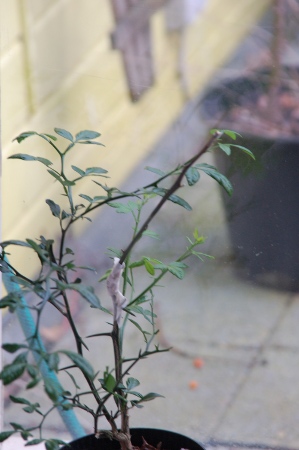
As you can see the rest of the plant is doing great, but the grafts I posted about several weeks ago didn’t make it.

So the lessons for me seem to be the following:

  • Citrus bud grafting is normally best done in summer or fall
  • I should have taped the graft tighter, and SHOULD HAVE USED PARAFILM TAPE.
  • I probably should have done something more to keep the scion wood from drying out.  For some time I had a plastic bag covering the entire plant, and Christina has a good way to do this with parafilm tape.

Well in a few weeks I plan to have another go with some apple trees…  Maybe this summer I’ll try something again with citrus.

Jamie Oliver TED Talk

While browsing Anne’s blog, I came across this great video of Jamie Oliver. I guess by now he’s someone pretty well known on both sides of the Atlantic. While I like Jamie a lot, there are clearly some points I disagree with him on, so I’m going to say something about these too.

To be honest, I have a problem with his strong imagery regarding sugar.

When it comes to processed foods containing sugar, and children especially consuming large quantities of this, there’s little to disagree with. Children don’t need sugar added to their milk to make it taste better, nor do they need artificial flavors and colors. In addition, there’s reason to be concerned about salt and fats in processed foods. While I say concerned, I want to be clear that moderation is key here, and those that have the most to worry about are people that eat only processed foods and little else.

There’s also little doubt that the healthiest food for anyone to eat is fresh, home cooked, locally produced and free of chemicals and pesticides. The healthiest diet is also one that emphasises fruits, vegetables and simple starches over animal products and other processed foods. This is particularly important for children.

On the other hand, sugar, salt and fats/oils are also perfectly normal cooking ingredients, that nearly all of us have in our kitchens. These are perfectly fine to use in cooking or to season your food. It’s absolutely crazy that some people think it’s unhealthy for the average person to add a spoonful of sugar to their tea or salt to their meal. If you’re diabetic, have high blood pressure or otherwise under doctors care, there may be some specific reason why you personally cannot eat certain things, but there’s no evidence to suggest it’s in any way unhealthy for the average person.

Many of us also eat modest amounts of processed foods containing these ingredients, like dairy, soft drinks, meats, and even things like soy sauce, catsup and so on. There’s little evidence to suggest there’s anything wrong with this. In fact there’s evidence to suggest that not only are these normal things to consume, they can also be healthy. There can however be many reasons for concern regarding how these foods are produced, and in general it’s becoming increasingly clear how important it is to think about this.

Food companies make huge profits by making people afraid of normal foods, and selling them supposedly healthy alternatives or by substituting something cheaper for these common ingredients.

Sugar is one of the most clear examples. In relative terms, sugar is expensive to add to processed foods. It’s price fluctuates on world markets, and supplies are not reliable. Soft drink companies have long sought alternatives to common sugars for their products. By using a sugar substitute, for example aspartame that’s commonly used in sugar free soft drinks, manufactures save an estimated 1.5 cents (US dollars) per can of beverage. This is a huge savings when considering how many cans of sugar free drinks are made each year. A similar savings can be had by using high fructose corn syrup (HFCS) instead of normal sugar, which is common in the US.

The problem is these sugar alternatives are linked to obesity, diabetes and other health problems. Statistically, people who drink soft drinks containing aspartame instead of sugar are heavier. In addition, the current obesity epidemic in the US corresponds almost exactly to the introduction of HFCS into processed foods and soft drinks.

There’s little evidence to show a connection between consuming modest amounts of ordinary sugar and weight gain. In fact, sugar is known to suppress appetite and many people who switch to sugar alternatives find themselves coping with a significant increase in hunger. Aspartame is a known appetite stimulant.

In simple terms, there’s little evidence to suggest an average adult without specific medical concerns is doing anything unhealthy by consuming modest amounts of fats, sugar or salt, as long as these come from natural sources. Specifically, there is no benefit in looking for alternatives to these foods. Certainly, no one should be afraid of these ingredients for use in home cooking.