

Robert of This and That recently contacted me about joining the Bloggers Seed Network. His blog has been around for years and I haven’t noticed it before. Anyway, have a look — Beekeeping, Gardening and Old Coins!
Milk and Rust
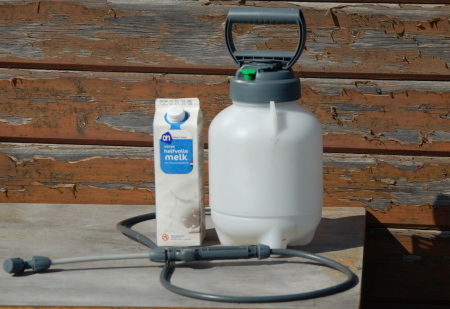
Garlic rust is very much on my mind at the moment. Last year around this time it appeared on my garlic, and it just appeared on Gintoino’s garlic in Portugal.
Søren had a good suggestion last year, spraying his garlic with diluted milk, and I’ve decided to try it this year. I’m mixing it about 1:5 with water, only because it’s most convenient to buy milk by the liter here and that’s what works well to fill my spray bottle and cover the plants. I understand nonfat milk is the best to use, but this is a special purchase here and hard to find reasonably priced, so I’m using lowfat instead. I’ve been doing this once a week for the last two weeks, and will keep doing it about this often or after it rains, until it seems pointless to continue.
There isn’t a practical way for me to do anything close to a scientific study here, with a control section of my garden, because once I have garlic rust anywhere it will spread quickly.
What I understand is garlic rust occurs at a time of high humidity, but not when the plants are wet. In my own experience, I see it break out in my garden most often when the days are warm, the nights cool and the humidity is high. Because it seems to be so tied to weather conditions, it doesn’t seem like comparing the date I got it last year with the date I get it this year is a good comparison.
Anyway, to help me figure out if the milk is helping, I would appreciate if anyone reading this who has garlic in their garden will tell me if and when they get rust this year.
Rust is primarily a European plant disease, so those of you in North America probably won’t see it.
Rust is not usually a deadly disease for garlic, but it does reduce the harvest and causes the plants to die prematurely. Delaying the appearence is what’s really important, because an infection two weeks earlier or later can mean the difference between a more or less normal harvest or one that has to be made early.
Bean Support
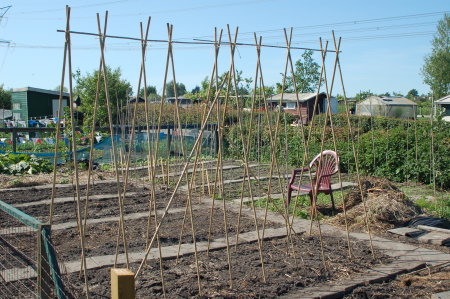
In my community garden this seems to be the standard design for a bean support structure. I haven’t really seen them before, so it’s probably not a really wide spread thing, and a lot of people in my garden are from other countries so this may not even be a Dutch design per se.
In my case, it’s 10 poles on each side intersecting at the top and tied to a horizontal pole. In addition, on both sides are diagonal poles for extra support. Wind is a real issue here, and this is clearly intended to stand up to a lot of it. I see some people using single poles, but otherwise everyone else uses this design.
I didn’t have any pole beans last year in the garden, so this is my first year trying this. Does anyone else use this design, or something similar?
Another Apple Tree Question
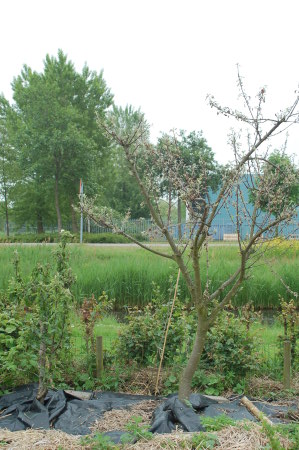
Does anyone have any idea what might be wrong with the apple tree on the right in the picture above? I’m sorry because of the background it’s hard to see, but it looks like it’s almost dead.
Here’s a close up of one of the branches. You can see the leaves have almost completely turned brown.
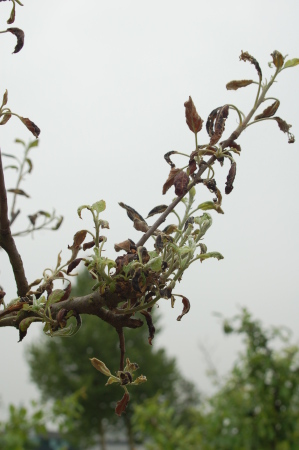
Below is a close up of the smaller apple tree on the left, and while it looks a lot healthier, perhaps it has an infection of some sort? Small brown spots and slightly withering leaves? Maybe it’s the same thing that is causing the problem with the almost dead looking tree?
The smaller, healthier looking tree on the left is the same tree I posted about several days ago that has the canker infection.
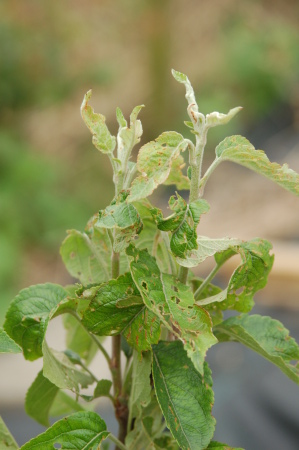
Here’s a little more information about the tree on the right:
Last year it produced apples, but after they were about 2cm in diameter they turned brown and fell off the tree. This year it didn’t set any fruit, but it did bloom.
I plan to remove the tree anyway, because it’s too close to the tree next to it (about 1m away) and it’s in the wrong part of the garden. Mostly I’m interested in understanding what’s happening. I’m pretty sure it’s the only pollinator available for the tree on the left, so I can’t remove it until I replace it with another tree of the same flowering period, or I won’t get any apples on the remaining tree.
The ground in this part of the garden is very poor and on the wet side, and the previous gardener was keeping these fruit trees alive with chemical fertilizer which I’ve stopped using. I did put quite a bit of compost around these trees this year. The previous gardener never pruned his trees, but I have been pruning them for the last 2 years since I’ve had this garden. I’ve planted some nitrogen fixing trees nearby, but they are too young and haven’t had a chance to fix any nitrogen yet. I also removed a nearby tree over the winter, so this tree has a little more space than it had last year.
The pH in my garden is mostly 6-6.5, and I did give these trees a few handfulls of lime this spring. While I don’t know exactly what the pH is here, it’s probably close enough to being right for apple trees.
Eurovision Song Contest
Those of you in Europe reading this are probably wondering what I’m doing writing a post on something like this, but for everyone else who’s interested in getting a taste of European culture, you may want to check out the Eurovision Song Contest website. The video above is Azerbaijan, but all the participating countries can be found on this website.
It’s hard to explain in just a few words what it’s all about, but it’s in the 54th year and the number of countries participating is very impressive. In Soviet times, stories came out of people listening on shortwave radios in secret, and and it being an important connection with the outside world for them. In modern times, the remaining Soviet block countries are putting forth some of the best performances.
Every year the contest is hosted by the country who won the previous year. Eurovision 2009 is being hosted by Russia in Moscow.
While all the videos are available for viewing online, either directly on their website or via YouTube, part of the attraction is to watch the contest unfold and see which countries vote for one another. While watching it, those of us in Europe can call an overpriced phone number to vote. Regions in Europe tend to form alliances, and various countries have special relationships with one another. Countries are not allowed to vote for themselves, but there are stories of bus loads of people crossing borders to vote from other countries. Some countries like the UK always seem to lose, no matter what. Everyone wonders why the announcements are still in French as well as English. We all wait to see if the Serbs and Croats will vote for each other, and so on. It’s a real lesson in European geography, politics and alliances.
Every country sponsors a performance, and many of them are really good! Others are not so good. Two years ago Finland won with what some people considered the worst video of the evening, as if people voted for them just to make fun of Eurovision. Eurovision is where ABBA got their start in the music world.
In past years every country got to make a performance on the night of the show, but in the last few years there are too many countries, so they have a complicated set of rules for semi-finals and finals. The semi-finals are past (I’m watching the last one as I type this), but the finals are this Saturday. Consider waching, live streams should be available from the website linked to above. If you can’t watch the show live, have a look at some of the Youtube videos.
