Hops

hop_pole1

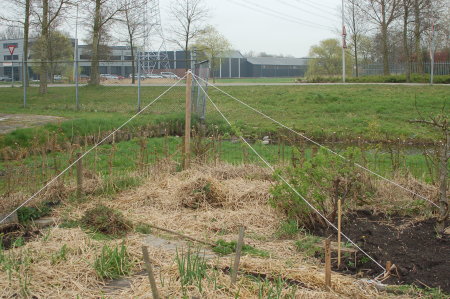
One of the plants I’m really excited about at the moment are hops Miss Fuggles just sent to me.  She sent me rhizomes from her three different varieties; Fuggles, Mathon and Cobb.  I don’t honestly know a lot about hops, but I’m eager to see how they grow.  I understand they can grow to 25ft (6 meters), but I understand these varieties won’t grow so tall.  At the moment I’m planning on about 16ft (4 meters).  If they get bigger, I’ll have to figure something else out.

I understand hops also like to grow vertically, but I don’t have any good way of building a 4 meter tall vertical structure in my garden, and the best I could come up with is what you see in the picture above, a pole with rope tied to the top at an angle.

Has anyone else grown hops?  Am I doing something terribly wrong?

hop_shoots

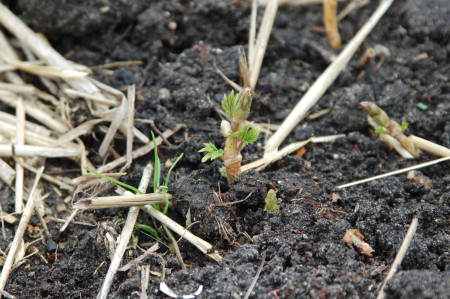
All three varieties survived the trip in the mail, and have started to grow.  They all look a bit like this right now.

As always, once these become established in my garden, I’ll be happy to send out more rhizomes to anyone else interested.

Planting at the White House Garden

flotus_garden4909

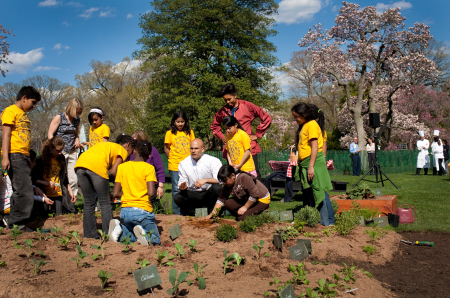
It’s planting time at the White House.  Here’s their blog post about it.

The First Lady looks more comfortably dressed for the garden this time!  Of course shoes are key, and we can’t see those here.

Update:  Since making this post, I’ve since seen in the Washington Post blog (after a mention on KGI) that they planted 25 varieties of heirloom vegetables, including a bed of varieties favored by Thomas Jefferson and a variety of Dutch lettuce.  It’s not clear if the garden is completely heirloom, but heirloom varieties are prominently featured!

The first lady also mentioned on her recent trip to Europe a great deal of attention was paid to her garden plans.  I can certainly confirm, there’s a lot of interest here in the garden, and lots of people are watching.

Gravel Path and Vinegar

gravel_path

See here for an updated post on this topic.

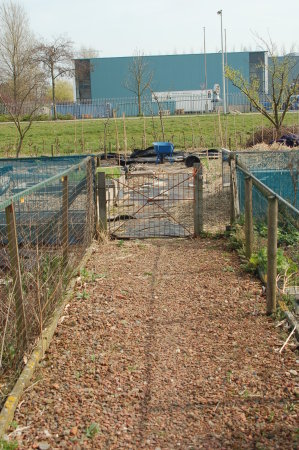
Here’s a picture from the other direction in my garden.  The blue wheelbarrow is right side up, but in almost the same place as the picture in the post a few days ago.  This is the path leading up to my two main plots.

We have these gravel paths all over the garden complex, and don’t have any say in them.  The city says we have to have them, and it’s just a rule we have to keep them clear.  Weeds in the gravel are really a problem, and it’s a lot of work to dig them out.  Every gardener is responsible for the paths in front of their plots.

Many of the gardeners in the complex are not organic, and use Round Up, even though this doesn’t work.  This doesn’t stop them of course from needlessly dousing their paths, hoping it might work a little bit someday.  I’ll admit, the Round Up does something, at least changing the color of the weeds a bit.

Taking an idea I got from a Mrs. Greenhands a while ago, I’ve decided to start using vinegar on my path.  I have the agreement of the gardeners on the two sides of the path to try this.  The logic is vinegar makes the gravel too acidic, so weeds won’t grow.

Before anyone eagerly rushes out to try this in your own garden, let me be clear.  Vinegar is not healthy for any plant and you can’t make things better by adding lime later.  Adding vinegar to your garden will probably ruin it for a long time and make it so nothing will grow.  Only use it where you are sure it cannot come in contact with an area you want to use for plants.

I’m not 100% certain I won’t cause problems in the neighboring gardens doing this.  I also don’t really have any idea how much vinegar I should be adding.

Has anyone done this before, and do they have any tips for me? At the moment, the vinegar doesn’t seem to be killing the weeds, but it is slowing them down and does appear to be keeping new weeds from becoming established.  So far I’ve only been using the vinegar for a few weeks, and I haven’t used that much.

It would sure be nice to offer an alternative to the Round Up!

Garden Pictures April 2009

garden_2009

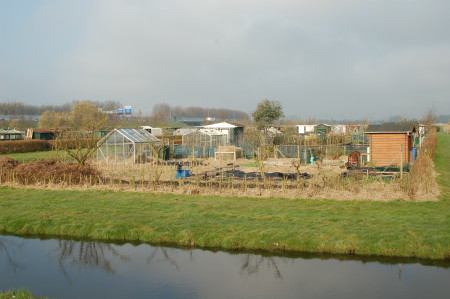
Here’s what the garden looks like.  For reference, the tiny patch of green in the middle is the spelt you see in the picture below.  You can’t usually see everything so clearly, but nothing has really started to grow and I recently did a very severe cutting back of the hedge, so it’s all a bit more visible.

The blue thing is my upside down wheelbarrow.  My garlic is growing on the left side, between the pile of brush left over from cutting the hedge and the greenhouse.  The straw is mostly for covering the garlic, but the main cost is having a local farmer make a delivery, getting extra straw is almost free, so I’m using it as a mulch for much of the rest of the garden.  I’m also using black landscape fabric in a few places.

You can’t really see, but there’s a line of fruit trees across the front, along the hedge.  There are all growing too close to each other, and the ground they are on is very depleted and waterlogged.  I trimmed them back pretty severely this year, as well as removing a few to give the others more space.  Only one tree gave edible fruit last year, and if the others don’t improve soon I’ll remove them all over the course of the next few years.  I’ve also planted some black alder trees next to the fruit trees as well as several other places in the garden, which are nitrogen fixing, in an effort to improve the soil and feed the fruit trees.

raised_beds

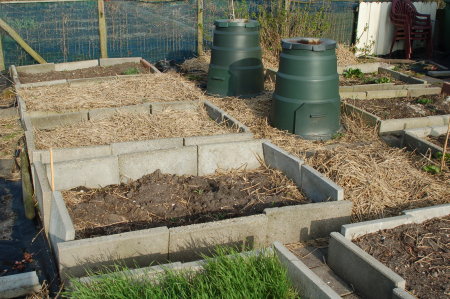
The guy who had the garden before me used it more for summer recreation than growing vegetables, and one of the things he did was put down a huge number of paving slabs, about 100 stones in total, taking up around 15% of the space in the garden with firmly established weeds growing aggressively through all the cracks.  They were a real maintenance issue, and were taking up too much garden space.  These are astonishingly heavy, with one slab being at about my lifting limit.  Getting rid of them was really going to be a problem, because it’s a long walk from my garden to the street and I was going to have to carry them one at a time.  Most things can be brought to the dump for free disposal, but not paving slabs, so I was going to have to pay to dispose of them.

It was really a lot of work, and took most of last summer, but the solution was to turn them into raised beds, 9 in total with plans for a 10th this year.  Not all the stones are straight, and I’ll have to fix this over time, but mostly I’m pretty happy with how it came out.

I made a sketch last year of the garden layout.   These raised beds are where the former patio in front of the shed was, as well as where the cold frame used to be.  You can see the red current plant in the back corner, but this will likely come out this year to make room for the 10th raised bed.

The green grassy looking stuff at the bottom is spelt I planted last year.

garlic_straw_2009

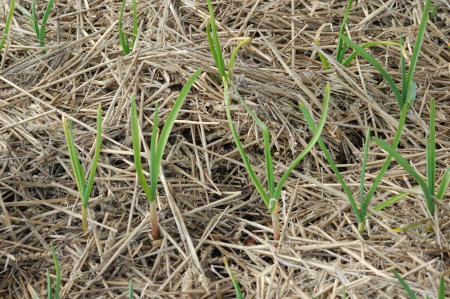
Finally here’s the garlic growing in the straw.  I have around 60 varieties growing this year, down from last year’s 100.  I’m growing about 1000 bulbs in total on about 45m2.  It’s looking good so far.

How to Plant a Modern Organic Garden

Okay, from the video in my post a few days ago we now know how to plant a Victory Garden, but how about the modern version?

The Technique

Make a list of what you think would be good to grow. Don’t worry if you’re not sure, this list will change over time. It’s important to have a place to start however.

Research crop rotations. In particular, when you begin you will probably organize your crops into four groups; Roots (carrots, beets, etc), Solancae (tomatoes, potatoes, peppers, etc), Brassicas (cabbage family) and Other. There is possibly a fifth group, being perennials (plants that keep growing from one year to the next).

After researching crop rotations, go back to your list of what you want to grow and research how much space the plants need. Try to fit what you want to grow in each of their four (or five) groups, and plan roughly equal space for them in your garden according to a rotation schedule. This step can be very time consuming and frustrating, just try to do the best you can, and instead of being perfect commit yourself to improving it over time. Be sure to incorporate something that fixes nitrogen into your rotation plan.

Get the seeds. If you know of plant diseases in your area, look for resistant varieties. At the same time, if you don’t have a particular disease, getting a resistant variety won’t help and will limit your choices. Get to know your diseases and pests, and plan for them specifically. While there’s no reason you can’t grow commercial seeds, be sure to pick some OP/heirloom varieties so you can save seeds as discussed below. Be sure to check out the Bloggers Seed Network!

Make a garden layout plan. This too will probably change over time, so make the plan in a way changes can easily be incorporated. Also make a plan for when things get started, indoor or outdoors, and when they should be transplanted. Don’t forget to harden off your plants.

If possible, do a soil test. If this is not possible or desirable, inventory the weeds of the area, and see if they indicate problems with your soil. Make a plan for dealing with any problems you discover. If chemical fertilizer has been used recently, you will have special problems connected with this.

Be sure to make your own compost with your garden and other waste. Also look for locally obtained materials to use for mulch.

Collect your own rain water.  Water can be diverted from the roof of most structures into a barrel.  Home made systems can be made with recycled materials for almost no cost.  Purchased systems are also widely available.

Organize your garden into beds. These can be raised or not, with or without a border. The important thing to consider here is you should be able to easily reach all parts of the bed without having to step in them. This usually means they should not be wider than about 4-5 ft (1,5m), with access from both sides.

Don’t use chemical fertilizers, uncomposted manure or chemical pest controls. If you feel it’s necessary to use some fertilizer, try making your own like compost or green plant ‘teas’. If you want to buy a commercial product consider kelp or fish based products. Fertilizer of this nature is normally best applied directly on the leaves of the plants as needed.  Remember, the taste of fish can find it’s way into your vegetables, so use sparingly and not close to harvest time.

In particular in the case of plants in the cabbage family, be sure to research common insect and plant disease problems. It’s a good idea to do this with other plants as well. Be sure to ask around to other gardeners. In the case of the cabbage family you will likely need to pick caterpillars off by hand, keep the plants covered with a net or use a product called Bt. You may need to cover your carrots to protect them from the carrot fly. If you grow potatoes you should understand what blight looks like, and be prepared to promptly remove infected plants or their foliage. There are also some blight resistant varieties becoming available.

Be sure to save seeds from your OP varieties. By saving your own seeds, you create special varieties uniquely suited for your garden’s climate.

Extra for Experts

After establishing your garden, you may want to think about planning your garden so you have fresh food available for as much of the year as possible, as well as using season extending techniques like cold frames and greenhouses.

You may also wish to try cross pollinating some of your varieties, in order to try developing new ones. This can only be done with OP varieties.

Finally be sure to check out other organic bloggers and websites for growing techniques and plant ideas:

Daughter of the Soil
Fluffius Muppetus
In the Toad’s Garden
Mas Du Diable
MustardPlaster
Observer Organic Allotment Blog
Plan Be
The Vegetable Garden
Veggie Gardening Tips

There are many others! Be sure to check out my Blogroll.

Please let me know what I’m missing here!